A construction ERP designed from the ground up around how contracting actually works: a frozen bill of quantities, cost that lands against it, claims that become certificates, and retention that is released once — with the separations of duty built into the system, not into a policy document.
THE STARTING POINT
Generic ERP Asks You to Describe a Project as a Sales Order
Horizontal platforms model a business as customers, orders and invoices, then leave a contractor to bend that shape around a bill of quantities, progress claims, subcontract chains and retention. The result is familiar: a finance system that is technically live and a commercial team still running the real numbers in spreadsheets.
CoreSync Construction ERP starts from the contract instead. The bill of quantities is a first-class document with a lifecycle. Cost entries are a ledger of their own. A progress claim, its certificate and the invoice it produces are separate acts performed by separate people. Nothing here was adapted from a distribution or manufacturing template.
THE SPINE
From Award to Cash, in One Chain
1Award and baseline. The bill of quantities is imported from the estimator’s own spreadsheet, priced, and approved. On approval the budget freezes: the baseline every later number is measured against.
2Controlled movement of the ceiling. A budget ceiling moves only through a credit request, raised by the project manager and approved above them. Nobody quietly edits an approved bill.
3Cost lands where it was spent. Purchase invoices, stock issues and timesheets post to a project cost ledger on submission, each entry carrying its project and cost centre, traceable back to the document that created it.
4Site reality, captured daily. Daily site reports come in from the people on site — progress, labour, plant, delays — so the commercial picture is not reconstructed at month end.
5Claim, certify, invoice. The project manager raises the progress claim. Someone else certifies it. Finance submits the invoice the certificate creates. Three acts, three people, in that order.
6Subcontract and retention. Subcontract agreements are authored by delivery and made binding by finance; retention is held and released as a deliberate, separate act.
Each step is a separate document with its own approval. The two highlighted steps — freezing the baseline and certifying a claim — are the control points everything else is measured against.
SEPARATION OF DUTIES
Nine Role Profiles, Defined by What They Cannot Do
Permissions are shipped as nine role profiles — CEO, COO, finance controller, project manager, zone project manager, cost control, site engineer and more — and each is defined as much by its refusals as its rights. The chief executive reads every figure in the business and submits almost nothing. The project manager writes the subcontract but cannot make it binding; finance does that. Cost control owns the budget and the actuals but has no authority over the contract. A project manager cannot approve their own credit request.
Scope is a second, independent layer: holding a role answers what someone may do, never on which projects. Project and zone assignments answer that, so a manager with full rights still sees only their own work.
9
Role profiles, assigned as a profile not a bare role
3
Separate hands between claim and cash
2
Independent layers: permission and project scope
No row has one owner end to end. The person who raises a claim never certifies it, and the person who builds the budget never moves its ceiling.
WHAT PEOPLE SEE
A Dashboard per Seat, Not a Report Menu
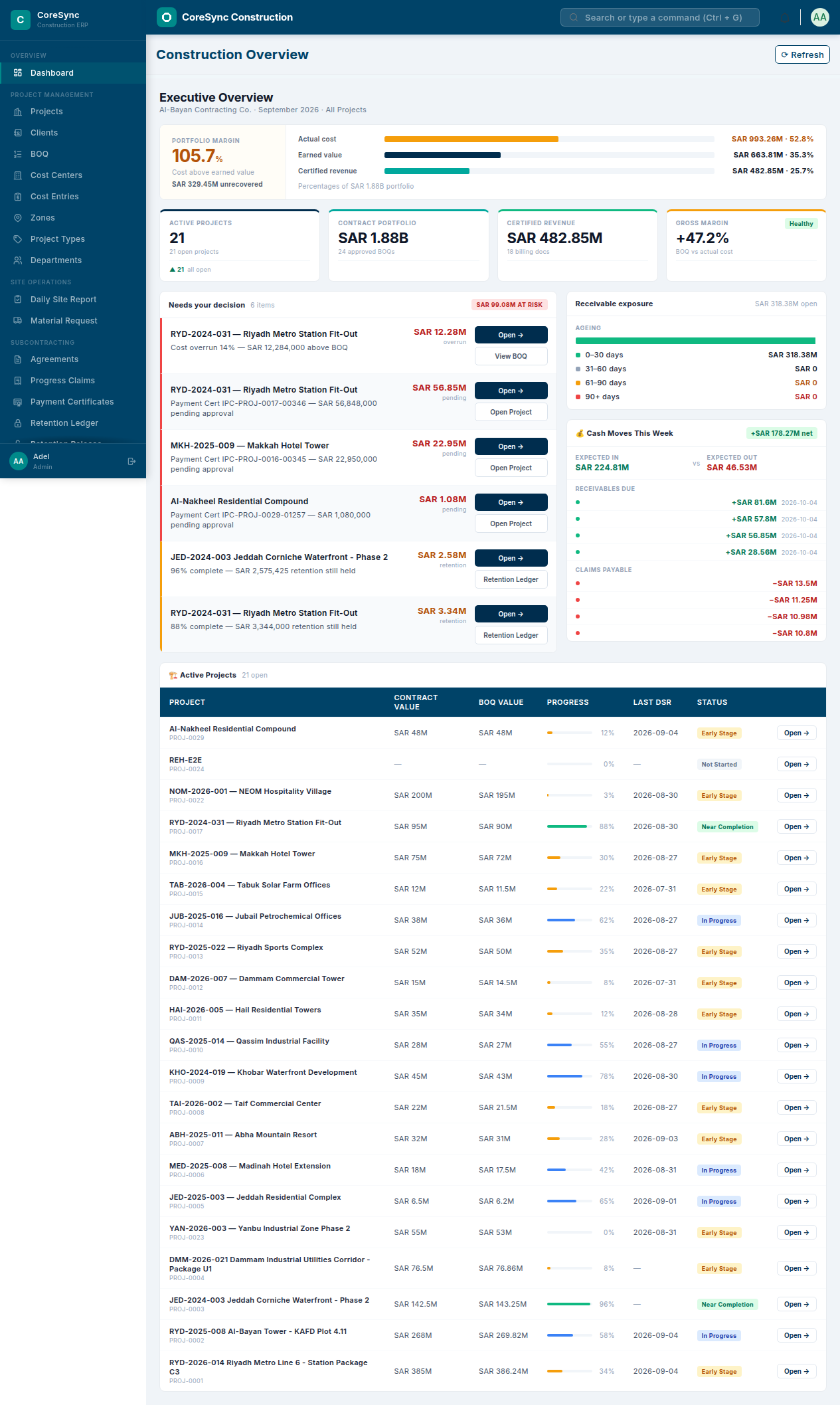
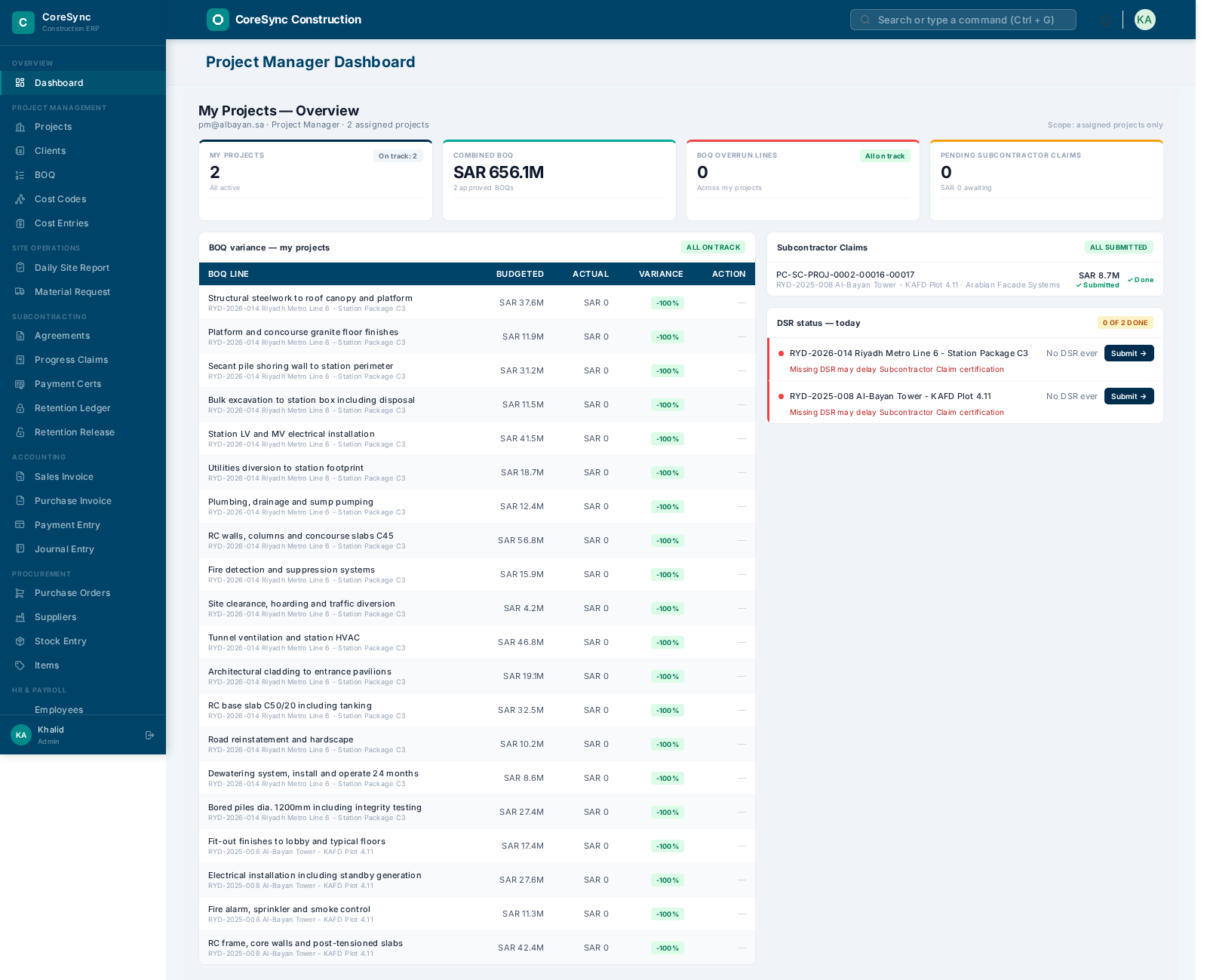
Each profile lands on the view built for it, rather than a generic workspace list. Executives see portfolio exposure; project managers see the variance and the claims on their own jobs.
Portfolio overview across active projects — contract value, gross margin, live receivable exposure and cash flow.
Project manager view — bill of quantities variance by line item, subcontractor claim status, and daily site report alerts for assigned projects.
COST TRUTH
Budget and Actual, Measured on the Same Basis
Earned value is only meaningful if both sides of the comparison are built the same way. An approved bill is priced from estimator rates that carry no tax, so actuals are compared on a net basis, in one place in the system rather than per report. Get that wrong and a line carrying ordinary VAT reports as an overrun — on a well-estimated bill, that is most of the lines.
Corrections behave like a ledger, not a spreadsheet. Cancelling an invoice posts a negating entry rather than deleting history, so a cost total always reconciles to the documents behind it and an audit can be walked backwards.
The same spend, measured two ways. At a 15% rate, comparing a gross actual against a net budget turns any line running up to 13% under budget into a reported overrun.
SITE CAPTURE
Approvals Where Your Team Already Is
Site engineers and subcontractors do not live in an ERP. Approvals and submissions reach them over WhatsApp, and structured site reporting from the same place is next: daily reports, material requests and delivery confirmations captured as structured records without anyone opening another application.
LIVE TODAY
Running with an active pilot client managing a SAR 1.88B project portfolio. We are accepting one further pilot engagement with a GCC-based contractor. Early-access partners get direct implementation support and a say in what gets built next.
Talk to the people who would do the work
No sales engineer in the middle. You speak to the engineers who would run the engagement.